 Venice Golf Cart Repair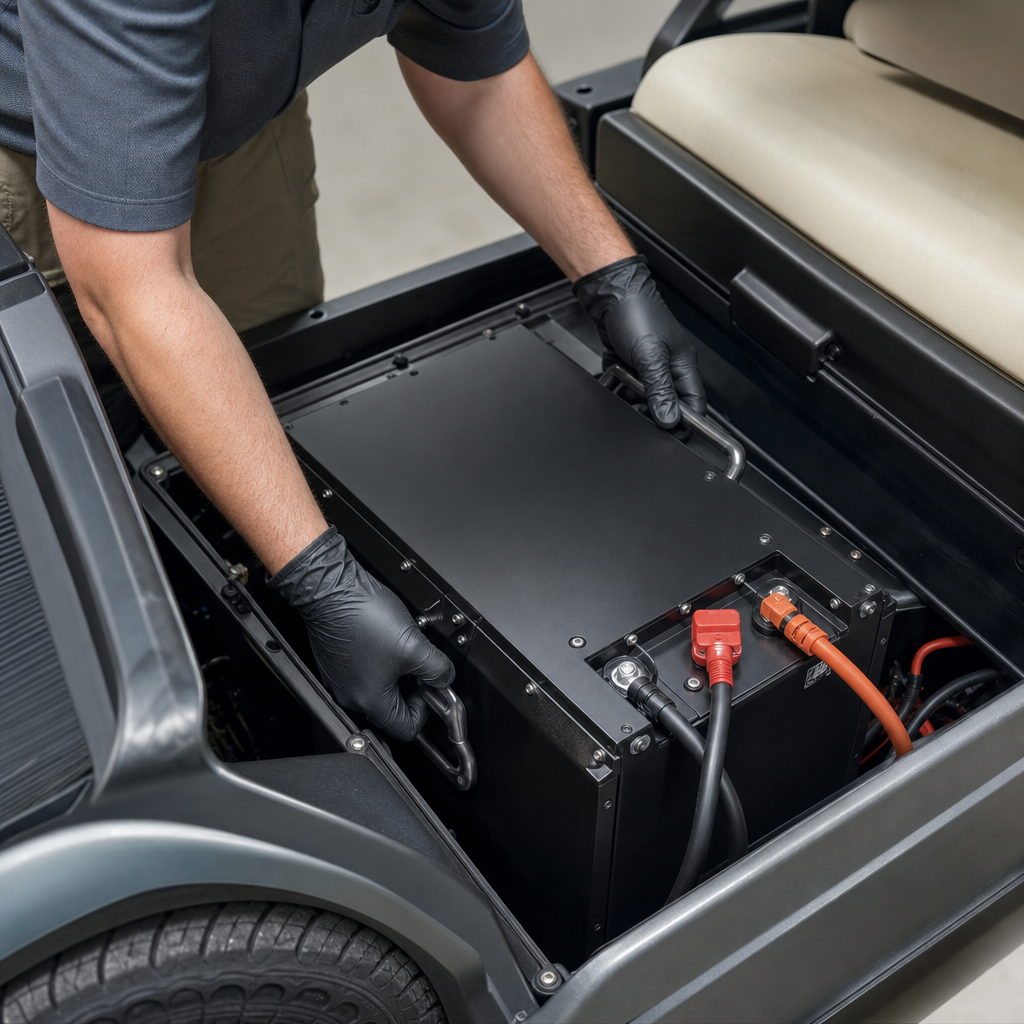
Venice Golf Cart Repair comes to your driveway, garage, or cart barn anywhere in Venice and South Sarasota County and fixes your cart on-site: battery packs, brakes, tires, chargers, solenoids, motors, and controllers. A full lead-acid battery pack runs $1,200 to $1,800 installed, brake work $75 to $400, tires $75 to $150 each, and the $50 to $100 service call is usually applied toward your repair. Describe the symptom by phone or form so we can bring the likely parts to the first visit.
Venice is a golf cart town by demographics before it is one by design. The 2020 Census put the city’s median age at 69.8, with 62.8 percent of residents 65 or older, and Census Reporter’s 2024 five-year estimate still shows a median age above 69. Across the county line of thinking, Sarasota County itself estimates more than 85,000 seasonal residents on top of roughly 488,000 year-round, most of them here from November into April. That is a lot of people whose cart is not a toy. It is the vehicle that gets to the clubhouse, the pickleball courts, the grocery store, and the doctor. When it dies in the garage, someone is stuck, which is why everything here is mobile and why a quick turnaround matters.
What gets fixed, at your home
- Mobile golf cart repair: the core service. On-site diagnosis and repair of whatever the cart is doing: won’t move, won’t charge, weak on the way back from the clubhouse, clicking, cutting out. All major brands, electric and gas.
- Battery replacement: new lead-acid packs installed with haul-away of the old cores, plus honest lead-acid vs lithium math for carts that run errands every day of the year.
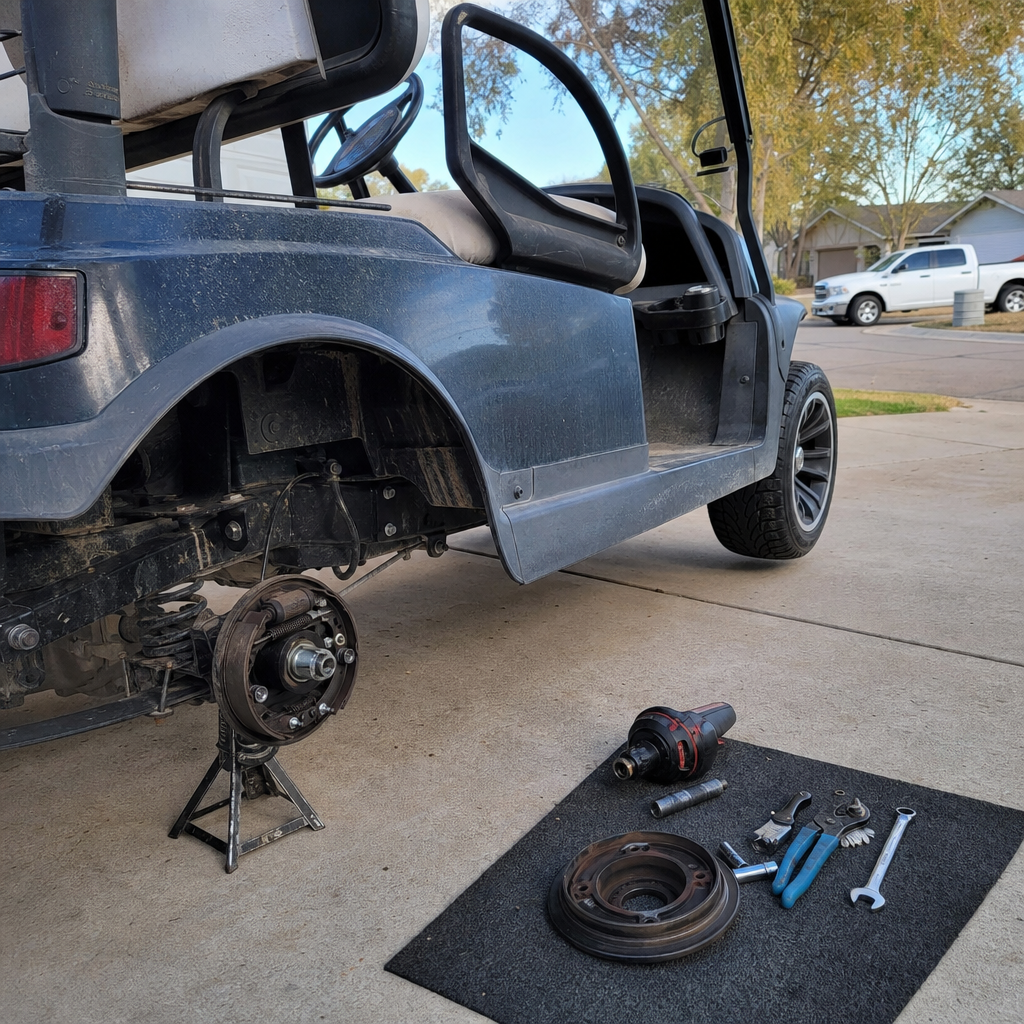
- Brakes and tires: the two fastest-wearing items on a daily-driver cart. Adjustments, shoes, drums, and new tires installed in your driveway.
- Motor and controller repair: solenoids, speed controllers, throttle inputs, and drive motors, diagnosed with meters instead of guesses.
- Charger repair: a cart that “won’t take a charge” is often a charger, charge-port, or receptacle problem rather than a battery problem. Get it tested before you buy anything.
- Tune-up service: the Gulf Coast annual: battery watering and load test, terminals cleaned and coated, brakes, tires, lights, connections, and a corrosion check that matters more within a few miles of the water than almost anywhere.
Full ranges for everything are on the pricing page. Most shops in this market make you call for a number. We publish ours so you can compare before you book.
Where the carts live in South Sarasota County
The cart-dependent geography here is specific, and it decides how quickly we can get to you.
Wellen Park. The West Villages Improvement District covers roughly 11,000 acres between US-41 and River Road, straddling the City of North Port and unincorporated Sarasota County with a Venice mailing address. It was renamed Wellen Park in October 2020, when Sarasota Magazine reported about 8,000 residents and a build-out plan of more than 20,000 homes and 60,000 residents. The original West Villages neighborhoods are the ones with the most carts on the road today: DiVosta’s IslandWalk (about 830 acres and 1,869 residences built between 2005 and 2021), Neal Communities’ Grand Palm (under construction since 2012), and Sarasota National (2,400 acres with an Audubon-certified course and roughly 1,300 acres of preserve). Newer sections around Downtown Wellen and CoolToday Park, where the Atlanta Braves hold spring training, add carts every month. The Wellen Park page covers the specifics.
Venice proper. John Nolen’s 1926 plan laid out the island on a grid of short, slow blocks either side of Venice Avenue, and the Zachos Realty guide to South County cart neighborhoods notes most of the island runs at 30 mph or below outside US-41. East of the Intracoastal, Venice Gardens is a 1950s-to-1970s concrete-block neighborhood bounded by Center Road, Jacaranda Boulevard, US-41, and Alligator Creek, and Jacaranda West, developed from the early 1970s around two 18-hole courses, carries about 900 residences with a heavy seasonal share. Plantation Golf and Country Club and the Venetian Golf and River Club (1,039 acres and 1,377 homes off Laurel Road on the Myakka) round out the gated cart country north and south of town.
North Port, Englewood, and up the Trail. North Port has Heron Creek (676 acres, more than 830 homes, a 27-hole Arthur Hills course) and Holiday Park, the 865-site 55-plus community that Hurricane Ian tore through in 2022. Englewood has Boca Royale’s 1,000 acres on the Sarasota County side and the flat back streets between Dearborn Street and Lemon Bay. Nokomis and Osprey sit up US-41 toward Sarasota, with 55-plus parks like Bay Indies along the Trail in Venice itself.
Why Gulf Coast carts break differently
Heat is the battery killer, not cold. The 1991 to 2020 NOAA normals for Venice put the average July and August high at 91.5 degrees, with an August mean of 83.1, and a battery compartment under a black seat sits well above ambient. A Department of Energy technical report on sealed lead-acid batteries states the rule of thumb the industry uses: every 15 degree Fahrenheit rise in temperature cuts battery life roughly in half. On a flooded pack, heat also drives water out of the cells faster; Trojan Battery’s own guidance is that letting electrolyte drop below the plate tops causes irreparable damage, and that higher temperatures increase self-discharge. Low water exposes plates, exposed plates sulfate, and sulfated plates never come back. A pack rated for five or six years of northern golf-course duty often taps out at four here. We wrote the full picture up in the three things that kill golf cart batteries in Venice.
Salt air is the quiet second killer. Venice Island, Nokomis, Casey Key, and Manasota Key put carts within a mile or two of open Gulf water, and Lemon Bay, Dona Bay, and the Intracoastal carry salt air well inland. Salt is an electrolyte: it makes moisture conductive and speeds corrosion at every place two metals meet, which on a cart means battery posts, cable lugs, charge-port pins, and brake hardware. Corroded connections add resistance, resistance mimics a dying battery pack, and owners end up shopping for $1,200 of batteries when the fix is a cable-and-terminal service. A test should always come before the quote.
The wet season never lets anything dry. Those same normals put 30.7 inches of Venice’s 51.27-inch annual rainfall in June through September, about 60 percent of the year’s water in four months. Garages stay damp, connectors oxidize, and brake cams seize on carts that sit. A cart parked for a summer up north comes home in October needing a tune-up before it needs anything else.
Hurricane season changes the job. Ian came ashore at Cayo Costa on September 28, 2022 as a Category 4 with 150 mph winds, and the National Weather Service’s extreme wind warning covered Osprey, Venice, North Port, and Englewood by name. The Venice Theatre lost its flyloft, Holiday Park in North Port was devastated by gusts near 100 mph, and one North Port gauge recorded 21.45 inches of rain. Helene and Milton put surge through Venice and Englewood again in 2024. Ahead of forecast weather, get charger and battery calls, because a fully charged cart matters most when the power goes out. Afterward come the other problems: carts that sat through an outage on a dead pack, saltwater in battery compartments, and chargers that took a surge when the power came back.
The 20-mph line: golf cart or LSV?
Florida Statute 320.01 defines a golf cart as a vehicle “not capable of exceeding speeds of 20 miles per hour” and a low-speed vehicle as one whose top speed is “greater than 20 miles per hour but not greater than 25 miles per hour.” That single number decides your rulebook.
A golf cart under F.S. 316.212 may be driven only on county roads or municipal streets the county or city has designated for carts and posted with signs, from sunrise to sunset unless it has headlights, brake lights, turn signals, and a windshield, and it must carry efficient brakes, reliable steering, safe tires, a rearview mirror, and red reflectors front and rear. Since October 1, 2023, when House Bill 949 took effect, a driver under 18 needs at least a learner’s permit and a driver 18 or older needs government-issued photo ID. Inside a gated community, the association’s private roads are the association’s rules.
A low-speed vehicle under F.S. 316.2122 must be titled, registered, and insured, driven by a licensed driver, and is allowed on any road posted 35 mph or less, with headlamps, stop lamps, turn signals, taillamps, reflectors, parking brake, mirrors, windshield, and seat belts required. Plenty of ICON, Evolution, Bintelli, and Kandi carts sold locally are LSVs from the factory. On those, brake and lighting work is required equipment on a registered motor vehicle, not an accessory, and it should be treated that way.
Whether a given public street in Venice, North Port, or unincorporated Sarasota County is designated for golf carts is a local decision under the statute, and the list changes. Check with the city or county before you take a sub-20-mph cart onto a public road, and ask our tech if you are not sure which kind of vehicle you own.
How a mobile visit works
- Describe the symptom. Won’t move, clicks but no go, won’t charge, sags on the bridge, squeals when braking. A good description usually narrows the fault before anyone arrives, so we can bring the right parts.
- We come to the cart. Driveway, garage, or cart barn, in a window agreed with you: anywhere in Venice, Wellen Park, North Port, Englewood, Nokomis, or Osprey. The $50 to $100 trip fee includes the diagnostic and is usually applied to the repair.
- Diagnosis before any recommendation. A load test on each battery, voltage checks across the pack, a charger output test, and solenoid and controller checks isolate whether the problem is batteries, charger, wiring, or drive system, before anyone talks about a four-figure pack.
- A flat number before the work. Battery sets, solenoids, brake shoes, and tires are common enough that a mobile tech often has them along. Approve the number and most jobs finish in that same visit.
- Finish clean. Flooded packs get watered to the correct level, terminals get cleaned and coated against salt air, hardware gets a torque check, the cart gets a test drive, and old batteries leave with our tech for lead-core recycling.
Straight answers, published prices
Two commitments. First, honesty about what we are: an independent mobile repair service, not an authorized dealer or warranty center for Club Car, E-Z-GO, Yamaha, ICON, Evolution, or anyone else. If your cart is under factory warranty, your selling dealer should handle warranty work. Second, honesty about what you need: a cart that won’t charge gets a charger and receptacle test before we quote a battery pack, a weak cart gets a per-battery load test before we condemn six batteries when one is the problem, and if a repair does not make sense against the value of an aging cart, we say so. More on how we work is on the about page, and the FAQ answers the most common questions around South County.
Get a fast quote
Stuck with a cart in Venice that won’t leave the garage? Call us first. Tell us the brand, gas or electric, the battery count if you can see it, and what the cart is doing. A photo of the battery compartment or dash helps. You will get a flat number and a scheduling window fast, before anyone heads out anywhere in Venice, Wellen Park, North Port, Englewood, and the rest of South Sarasota County.